A sheet from James Madison's ledger The sheet containing Haym Salomon’s name is the only known surviving page from the book. (Courtesy The Raab Collection)
Salomon was also one of the founders and main donors to Mikveh Israel, a Philadelphia synagogue, still active today, nicknamed the ‘Synagogue of the American Revolution.’
By Jackie Hajdenberg, JTA
After 10 years on display at Philadelphia’s Weitzman National Museum of American Jewish History, a document penned by James Madison linking Jewish financier Haym Salomon to the American Revolution is now for sale.
The document, a sheet from the ledger of Madison, who later became the fourth U.S. president, showed the Virginia delegation’s expenses and receipts during the 1780 Continental Congress.
It lists contributions from Salomon, a Sephardic Jewish immigrant from Poland who came to America in 1775 and is considered one of the leadingJames Madison
funders of the Revolutionary War effort.
The sheet containing Salomon’s name is the only known surviving page from Madison’s ledger.
The page is currently owned by the Raab Collection, an international firm that specializes in the buying and selling of important historical documents.
The Raab Collection has previously sold a letter from Theodore Roosevelt stating that he wanted a Jewish person at his side during his nomination for the Republican presidential ticket in 1904 and an original copy of the United States’ official recognition of the State of Israel, signed by President Harry Truman.
“Jews in early America were strong patriots and fought for freedom alongside their Christian friends and neighbors,” Nathan Raab, the collection’s president, said in a statement. “This meant that our Founding Fathers had Jewish friends, supporters, and allies at the dawn of our nation. This document shows that vividly.”
Salomon was a financial broker for merchants. A backer of the American Revolution, Salomon joined the Sons of Liberty in 1775 and was arrested the following year by the British and accused of being a spy for Gen. George Washington.
He was arrested again in 1778 and sentenced to death, but reportedly bribed his jailer and escaped to Philadelphia, where he continued his work as a broker, providing loans to prominent American figures including Madison.
Salomon is estimated to have given about $600,000 of his personal fortune toward the American Revolution — about $23 million in today’s dollars. He died at 44 in 1785, less than two years after the treaty ending the war was signed, and was destitute because his loans had not been repaid.
Salomon’s significance went unrecognized for nearly a century and was then disputed for some time.
In 1927, after the United States had celebrated its 150th birthday, New York City rejected an offer by a Jewish immigrants’ group to build a statue of Salomon in Madison Square Park, citing an assessment that he was merely a mercenary and not a true believer in the American cause.
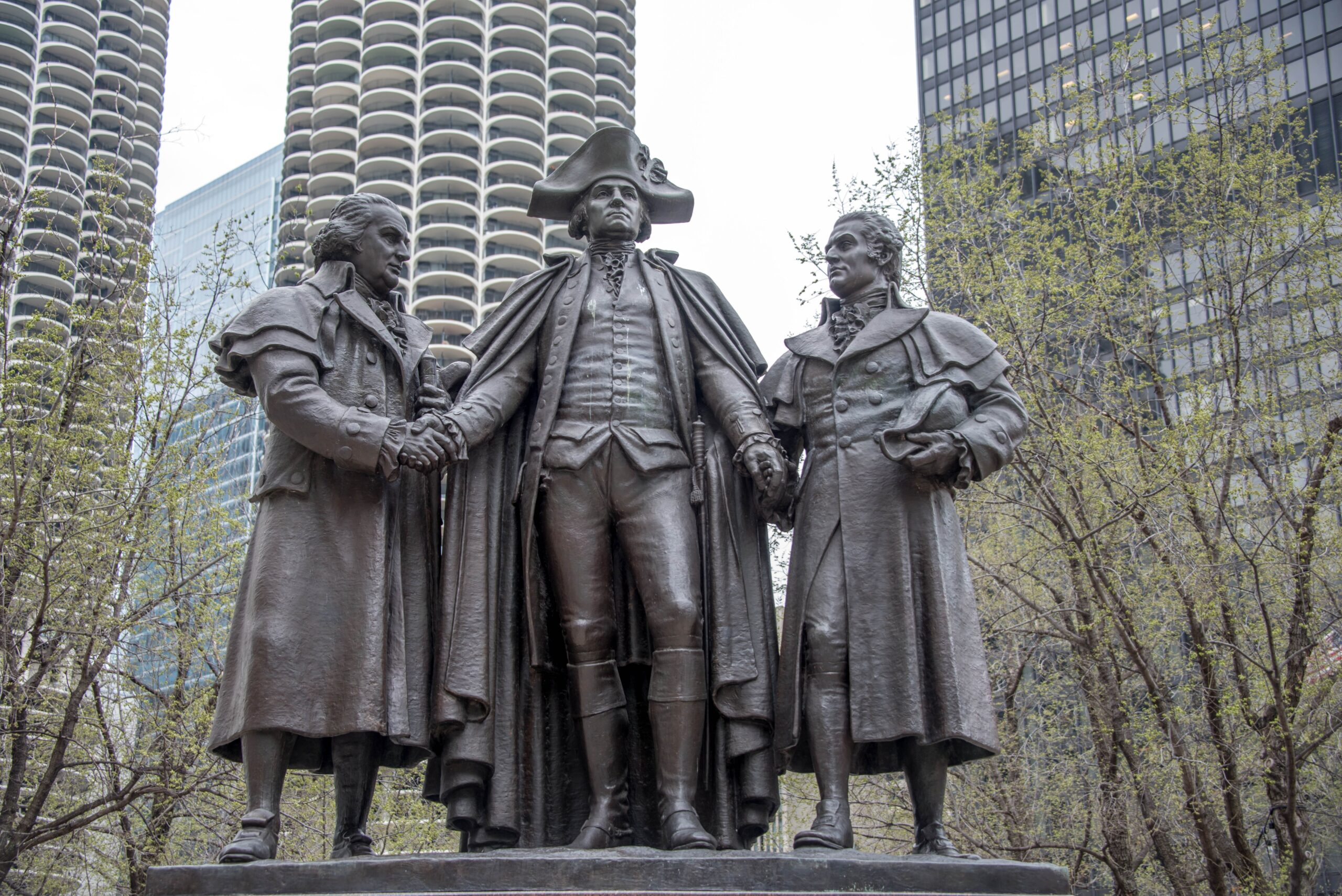
Later, infighting between Polish and German Jews in the city caused a second memorial plan to be scuttled. A memorial was finally erected in Chicago, where it had the support of a large Polish population, in the 1930s.
Herald Square Monument bronze sculpture of George Washington, Robert Morris, and Haym Salomon by Lorado Taft. (Shutterstock)
By the following decade, a positive narrative had solidified around Salomon.
Salomon was also one of the founders and main donors to Mikveh Israel, a Philadelphia synagogue, still active today, nicknamed the “Synagogue of the American Revolution.”
There is contemporaneous evidence of Madison’s relationship with Salomon but the ledger page, which the Raab Collection has priced at $50,000, is the only document from the era showing the amount of money he loaned the nascent United States.
“I have for some time been a pensioner on the favor of Haym Salomon,” Madison wrote in a 1782 or 1783 letter to Edmund Randolph, who later became secretary of state. “The kindness of our friend near the coffeehouse is a fund that will preserve me from extremities, but I never resort to it without great mortification, as he obstinately rejects all recompense.”
Whether the document remains on public view will be the decision of the buyer, if there is one. A spokesperson for the Weitzman Museum, which is seeking to become part of the public Smithsonian network of museums, said on Friday that she was unaware of the potential sale.
Soldiers from the 890th Battalion opened fire on the vehicle, killing one of the terrorists…
The warning comes as concerns grow over a possible attack on the eve of Yom…
Two separate Palestinian terror attacks in Samaria just hours before Yom Kippur, with one man…
Austrian party with ties to far-right pushes to reset relationship with Jews and Israel.
A Qatari security official revealed that Qatar had preplanned evacuation measures to safely escort Hamas…
Israeli man detained and drafted into Ukrainian army after making Rosh Hashana pilgrimage to Rebbe…