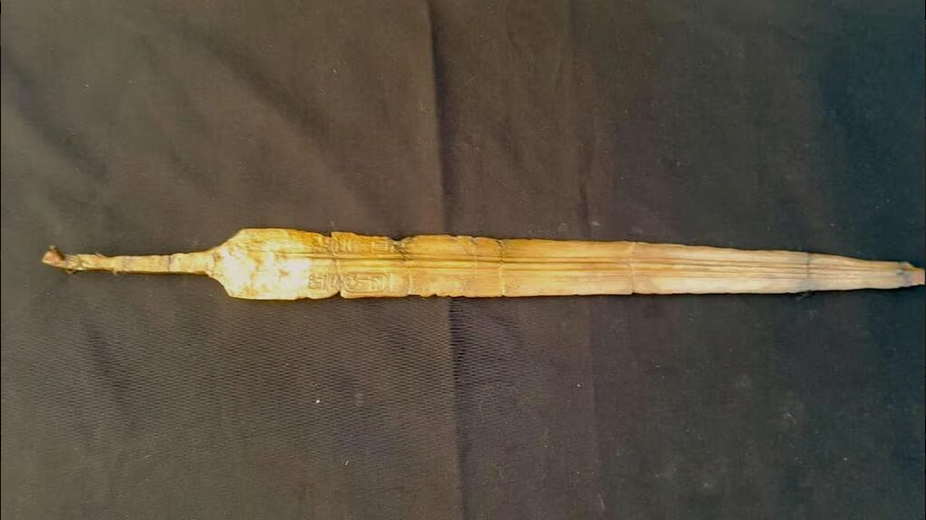
The sword of Ramses II. (X Screenshot)
According to Egypt’s Ministry of Tourism and Antiquities, besides the sword, researchers found what were essentially ancient mess halls and kitchens.
Egyptian archaeologists have found what they believe is a sword linked to the Pharaoh who was famously told by Moses to “Let My People Go” as recounted in the Torah.
The 3,200-year-old bronze ceremonial sword bearing the name Ramses II in hieroglyphics was discovered in the remains of an ancient military complex at Tell Al-Abqain.
While the exact age of the fortress remains uncertain, it operated during the reign of Ramses II who held Egypt’s second-longest rule (1279-1213 BC).
This period, known as the New Kingdom, was marked by economic and political prosperity but also war.
Under Ramses II’s leadership, whose name was also found inscribed on limestone at the site, Egypt engaged in multiple conflicts with the Hittites and Libyans.
Of course, he is famously referenced in the Torah as the ruler who refused to let his Jewish slaves free until the 10 plagues rained upon his kingdom.
According to Egypt’s Ministry of Tourism and Antiquities, besides the sword, researchers found what were essentially ancient mess halls and kitchens.
The soldiers had dedicated storage areas filled with large grain bins and massive clay pots still containing old fish and animal bones.
They even uncovered the remains of cylindrical clay ovens where meals were once prepared.
The excavation also yielded a wealth of personal belongings from the soldiers’ daily lives, including military weapons, hunting equipment, personal adornments, and ivory kohl applicators.
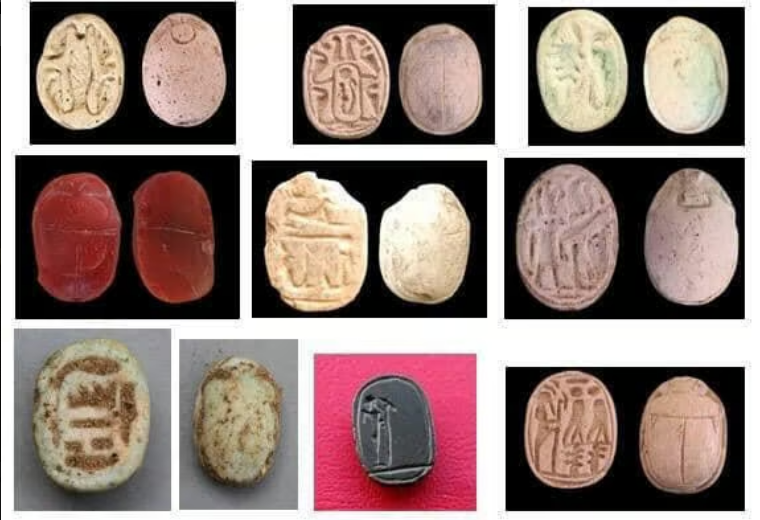
Necklaces crafted from carnelian and faience beads, along with a partial bronze ring as well as various scarab beetle artifacts referencing Egyptian deities were unearthed at the site as well.
Notably, archaeologists found a cow burial site, significant given the ancient Egyptians’ view of cattle as symbols of divine power, strength, and prosperity.
This ritual finds a compelling parallel in the biblical Passover story, when the Jews sacrificed sheep – animals the Egyptians revered as gods – to symbolize their freedom.”
United Torah Judaism denies reaching a coalition agreement as negotiations are expected to become public.
Central Command chief praises farmers and settlement communities for their sacrifices alongside security forces.
The IDF struck dozens of Hezbollah rockets and launchers at a Radwan Force training camp,…
Eighty-five percent of Gaza’s hospitals have been used by Hamas and Palestinian Islamic Jihad for…
Soussana has talked about her sexual abuse at the United Nations and the White House,…
This hilarious skit shows how to handle your anti-Israel relatives at Thanksgiving, with smart comebacks…