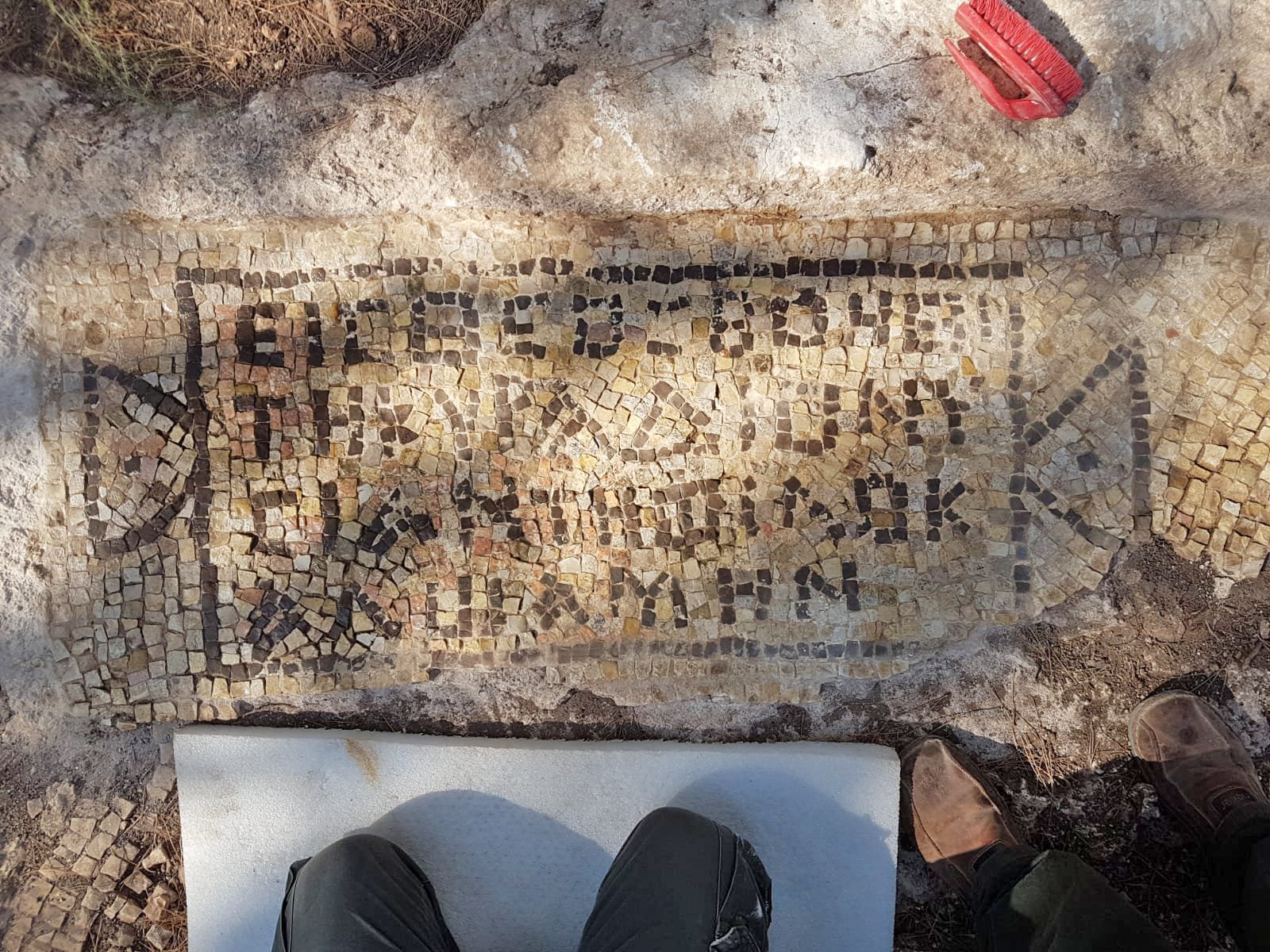
At the Samaritan site. (Israel Antiquities Authority)
Archaeologists made the discovery as part of a major excavation, finding a rare inscription that points to the existence of a large Samaritan settlement in the area.
By World Israel News Staff
“Only God help[s] the beautiful property of Master Adios, amen,” reads a 1,600-year-old inscription found during an Israel Antiquities Authority excavation at Tzur Natan, which is located on the southern Sharon Plain not far from Samaria.
The excavations ended this week and were initiated by the Israel Land Authority prior to construction of a new neighborhood in the area.
Professor Leah Di Segni of the Hebrew University of Jerusalem deciphered and translated the inscription, which was written in Greek and is dated to the early fifth century CE.
This period represents the apex of Samaritan culture in the southern Sharon Plain.
According to Dr. Hagit Torge, who oversaw excavations on behalf of the Israel Antiquities Authority (IAA), “The inscription was discovered in an impressive wine press that was apparently part of the agricultural estate of a wealthy individual called Adios.”
“Only God help the beautiful property of Master Adios, amen,” reads the inscription. (Israel Antiquities Authority)
She added, “This is only the second such wine press discovered in Israel with a blessing inscription associated with the Samaritans. The first was discovered a few years ago in Apollonia near Herzliya.”
Not far from the wine press, archaeologists also discovered infrastructure for cultivating grapevines, including stone quarries with rock-cut depressions, which are thought to be part of Adios’ estate.
The wine press was discovered near the Tzur Natan Samaritan synagogue, which was turned into a church in the sixth century. Nearby, a compound was discovered previously for producing wine, oil and flour. In one of the adjacent chambers, archaeologists discovered a Pompeian donkey mill, adorned with a seven-branch candelabra.
According to explanatory material issued by the IAA, “The Samaritans were originally brought to this country as part of Assyrian policy and first settled on and around Mount Gerizim. Over the years the population grew and expanded to the southern Sharon Plain among other places.
“They maintained their special customs and traditions, which resemble Jewish traditions in many aspects. During the Byzantine period the Samaritans revolted against the government in an attempt to maintain their identity. After the revolts the community diminished in size and returned to the Mount Gerizim area. A Samaritan community still lives at Mount Gerizim, as well as in the city of Holon south of Tel Aviv.”
Because Green members approved the motion, it is now party policy, although it will not…
Zamir approved plans for continued operations and stressed the importance of thwarting terrorism and maintaining…
Recent developments have opened a new economic dispute between Washington and several Western European governments.
With Israel’s election just weeks away, Netanyahu may be facing his final shot at eliminating…
Brig. Gen. (res.) Yossi Kuperwasser said he did not view the incoming U.S. assets as…
The IDF’s 99th Division spent four months in northern Gaza wiping out more than 100…